Tournament poker, written down.
Essays on the money side of tournament poker: how much to risk, why swings are bigger than you think, deals, staking, mystery bounties, late registration. Written from inside a big staking group, then turned into the app. New essays go out on Substack; subscribe there for new posts in your inbox.
The math behind the app.
Three papers: how we read a player, how we compare players, and how we price action. The essays below say the same things in plain words.
- № 1
ELCOMBO — The Placement Tool
The math that turns a player’s results into the odds of every finish in a tournament. Two numbers describe a player; everything else follows. Shared with Stable-tier and consulting clients.
In-session circulation - № 2
MUCHO — The Map of the Field
A map of thousands of player groups by buy-in, speed, game type, field size and site, and the rule that says how much to trust your own results versus the group. Same circulation.
In-session circulation - № 3
MOTA — Investment Engineering on Tournament Outcomes
How much of a tournament to sell, at what markup, and which tournaments are worth your time. Never worse than plain Kelly, often better. Public, 5 pages, Nov 2023.
Download PDF →
Cite: Dahlke, F. (2023). MOTA — Investment Engineering on Tournament Outcomes. Mota GmbH. https://muchomota.com/papers/mota-whitepaper.pdf
Start here.
- Bankroll management for tournament poker players. Tournament poker bankroll management isn't 'keep 100 buy-ins'. It's a question about geometric growth under variance — what fraction of your bankroll you can risk per event without going broke and without growing slower than you should. The honest answer is fractional, calibrated to your edge, and almost always smaller than the conventional rule of thumb.
- Kelly criterion for poker tournaments. The Kelly criterion answers one question for a tournament poker player: what fraction of your bankroll should be in a single event so that your long-run geometric growth is maximised? The closed-form answer is g = μ − ½σ². For top-heavy MTTs, this means risking less per buy-in than most rules of thumb suggest — and selling action above a threshold markup whenever you can.
- What tournament poker variance actually looks like. Tournament variance dwarfs cash-game variance at the same nominal ROI. Top-heavy MTT payouts mean a 1,000-runner event concentrates most of its EV in finishes that happen 1–2% of the time, so your realised year is shaped by a handful of deep runs that may or may not arrive. Most simulators get this wrong; here's what an honest variance picture looks like.
- How poker staking actually works. Poker staking is a contract market built on top of a high-variance game. A staker buys a fraction of a player's tournament action at a markup; the player gets variance reduction and capital, the staker gets exposure to a player they couldn't buy on the open market. The economics are tighter than they look — fair markup, makeup, swap pools, and audit are all consequences of the same incentive math.
- Mystery bounty strategy and variance. Mystery bounty tournaments concentrate even more variance into the post-bubble field than standard MTTs. The bounty pool's lottery structure rewards survivors disproportionately, distorts ICM relative to standard payouts, and changes optimal bankroll sizing for any player who runs them seriously. Here's how the math actually works.
Worked examples.
Real screenshots from the live app, one scenario per entry. Terms are in the glossary.
- Solving Bankroll Management for Tournament Poker · Free on YouTube too
- Solving Bankroll Management: Kelly Criterion
- ROI Science: Two-Parameter Sufficiency
The full series is on runitonce.com.
Most recent
-
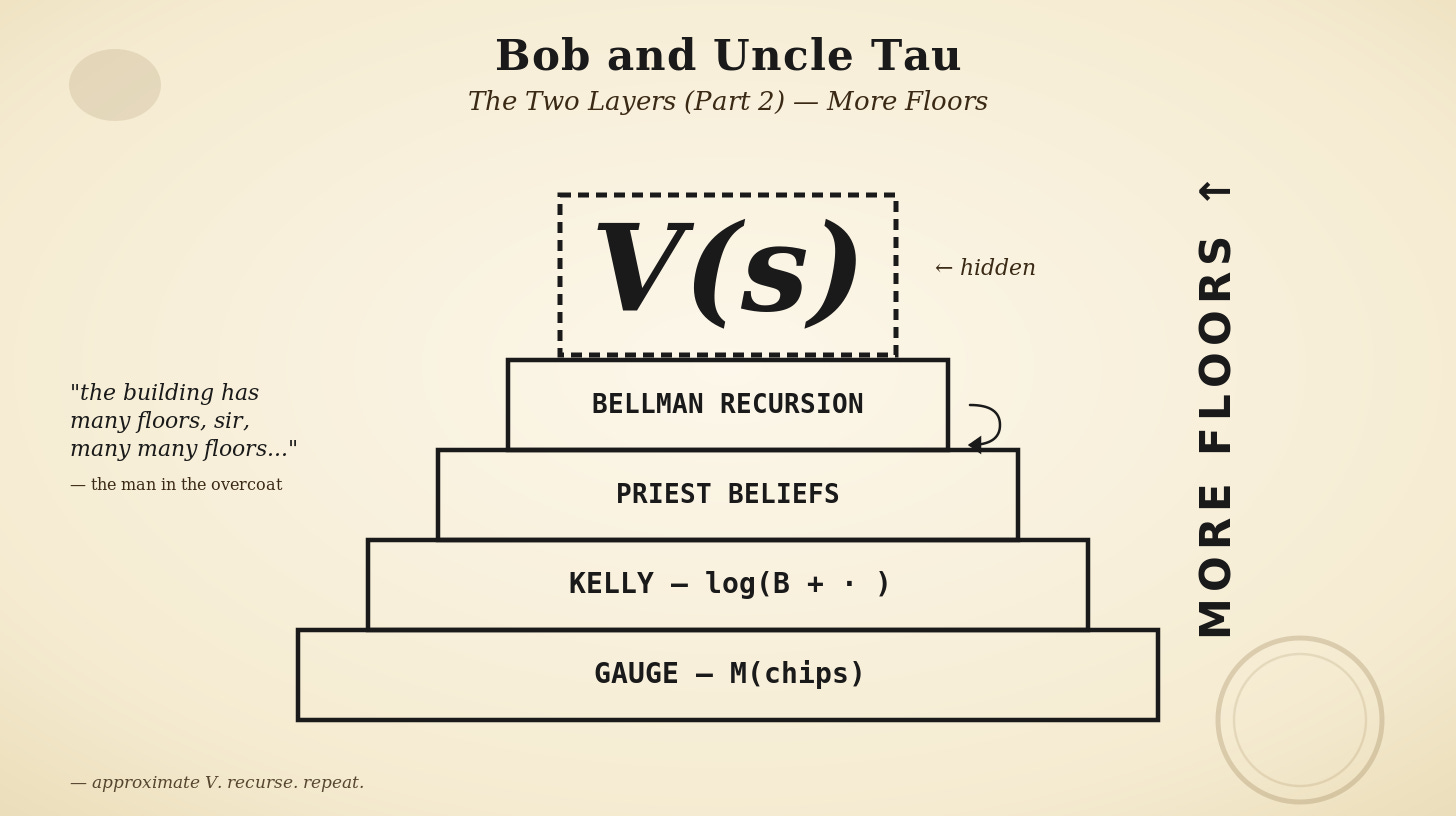
Bob and Uncle Tau: The Two Layers (Part 2 of 2) — More Floors
Previously in Part 1: Bob had been reading Diaconis-Ethier 2022 — the paper where ICM disagrees with gambler’s-ruin elimination probabilities by a factor of 600 at the short-stack corner — and called Uncle Tau in distress. At the back of the taquería he got a lecture about why “which model is right” is a category…
-
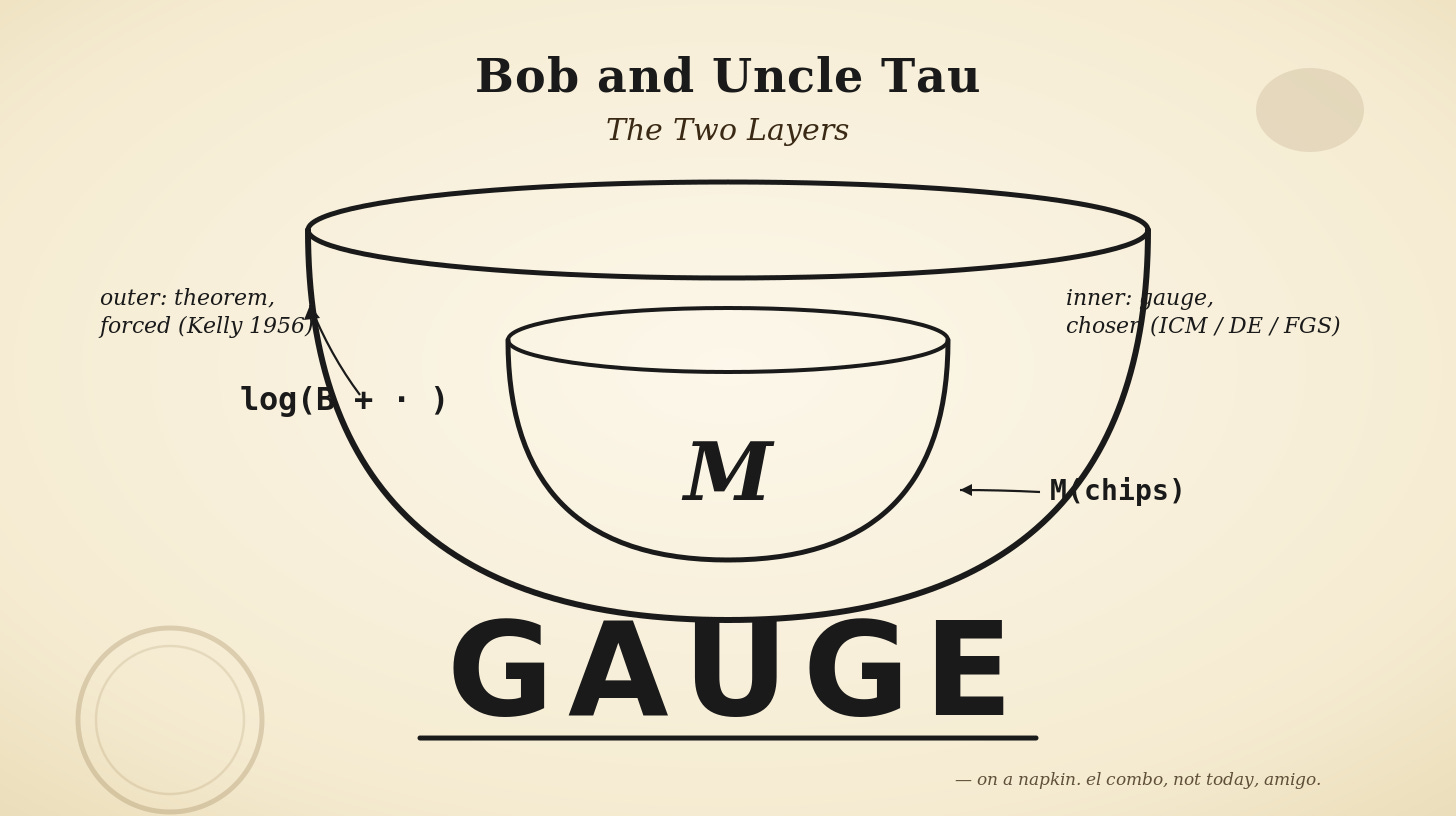
The Two Layers (Part 1 of 2)
In which Bob tries to figure out whether a paper by Persi Diaconis means ICM is wrong, and Uncle Tau explains that the question itself is a category error — ICM was never a utility, and neither is its replacement, and there’s a correction on top that nobody in the forum fight has heard of…
-
The Roman Extraction
Date: March 2026 Location: Helsinki, Finland — Sam’s Apartment Status: Sam is free. The sauna is 94°C. The Beamer is parked outside. The ultra-silent PC hums at a frequency only dogs can hear. Life is beautiful. Bankroll: Sam: Healthy. Bob: $12,400. Roman: $5,000,000 in the red — and locked in a cell with WiFi. Roman…
Bankroll & Kelly
Sizing, growth, treasury — what the math actually says.
-

The Thinking Pro's Poker Finance: Growth, Swaps, and Selling Action "Below Your EV"
The "Variance Delta": Selling for Stability and Faster Compounding – A Deeper Look Consider that $1k tournament (a player with a 20% ROI) and a market offering a 1.10 markup. Instead of just asking "Is 1.10 < 1.20, so I'm 'losing' EV on this piece?", MOTA asks: "What fraction of my action, if sold at…
-
Treasury Management for Poker Players
Bob plays poker. Not badly, but not particularly well either. He grinds mid-stakes, has flashes of brilliance, and still somehow finds a way to be out of action at least once a month because his "money is stuck." Bob’s life is a case study in non-robust financial behavior—and he's the perfect antihero to show us…
-
The Kelly Criterion Is Misunderstood—Here’s What We Should Really Focus On
Introduction If you’ve ever delved into discussions about optimal betting strategies—whether for investing, poker, or other forms of gambling—you’ve likely come across the Kelly Criterion. Most treatments of the topic focus almost exclusively on the “fraction” of your bankroll to bet. In poker circles, you’ll often hear about “fixed bets” or “all-in” approaches that don’t…
-
Every Bankroll Management Strategy is a Fractional One
Every Bankroll Management Strategy is a Fractional One In the world of poker tournaments, bankroll management is a topic that every player encounters, regardless of skill level or experience. While strategies and approaches may vary widely, there's a fundamental principle that underpins every decision you make: every bankroll management strategy is inherently a fractional betting…
Variance & Monte Carlo
Drawdowns, antifragility, and why naive simulators lie.
-
On Entropy (And Other Excuses for a Bad River Call)
The Finnish high-stakes legend Elmerixx famously said that at the highest levels, " Our job is to handle uncertainty." This is a deceptively simple statement. It is also the most precise and complete description of the professional poker problem. When stripped of its romanticism, the job boils down to the management of a single physical…
-

Embracing Disaster: The Luxury of Losing Big in Poker
In the high-stakes world of tournament poker, risk isn’t just a possibility—it’s a prerequisite for greatness. The audacity to flirt with a 6–7 figure downswing is not a mark of failure but a badge of having truly entered the arena of the elite. After all, you can only lose millions if you’ve first convinced someone…
-
Mystery Bounty Tournaments: High Variance Meets Big Opportunity
Mystery Bounty tournaments have carved out a niche in the poker world with their blend of randomness, skill-driven knockout collection, and highly skewed payout distributions. While recreational players flock to these events for the chance at a “golden bounty,” professionals face a tradeoff: the potential for increased mean ROI due to softer fields versus higher…
-

Embracing Uncertainty: Harnessing Antifragility in Tournament Poker
In the high-stakes world of tournament poker, uncertainty isn't just an occasional hurdle—it's the very fabric of the game. As tournament players, we are intimately familiar with the reality that losses are more common than wins. However, it's this very understanding that equips us to handle volatility better than most. Drawing inspiration from Nassim Taleb's…
-

Flaws in Monte Carlo Simulations for Poker Tournaments: The Case of PrimeDope
Introduction Imagine meticulously analyzing your poker tournament strategies only to discover that your predictive tools consistently underestimate the inherent variance. This mismatch can lead to misguided decisions and unrealistic expectations. In the competitive world of poker, where skill significantly influences outcomes, understanding and accurately predicting variance is crucial for effective bankroll management and strategic planning.…
ICM & Deals
Final-table chip math, heads-up deals, and brinkmanship.
-

Brinkmanship as a Default: The Game Theory of "ICM is for Pussies"
There are few phrases in poker so tied to one person as Doug Polk's declaration: "ICM is for pussies." It's typically framed as a battle between mathematical purists and fearless cowboys. This framing is incorrect. The statement is not a rejection of math; it is the public-facing component of a masterclass in applied brinkmanship ,…
-

The Art of the Deal: A Rational Actor's Guide to Heads-Up Deals
The tournament ends. Two players remain. The negotiation begins. In this crucial moment, most players get lost in the fog of war, arguing over a fuzzy, unquantifiable "edge." They are operating on feel, on ego, on "bro science." They are asking the wrong questions. Thanks for reading Muchomota! Subscribe for free to receive new posts…
Staking & Action
Markup, makeup, swaps, stable accounting, incentive design.
-
The Roman Extraction
Date: March 2026 Location: Helsinki, Finland — Sam’s Apartment Status: Sam is free. The sauna is 94°C. The Beamer is parked outside. The ultra-silent PC hums at a frequency only dogs can hear. Life is beautiful. Bankroll: Sam: Healthy. Bob: $12,400. Roman: $5,000,000 in the red — and locked in a cell with WiFi. Roman…
-
Accounting for Poker Stables with Rich Hickey’s “Database as a Value” Principles
How leveraging time-travel and immutable data models solves the complexities of poker-stable accounting. Disclaimer: For the Poker Players Reading This If you’re a poker player stumbling across this blog, let me save you some time: this post will not teach you how to make more money at the tables. Seriously, if you’re concerned about maximizing…
-
From Full Staking to MOTA: Streamlining the Process with Investor Pools
If you’re a professional (or aspiring professional) tournament poker player, you’ve likely encountered a classic staking deal where: A backer covers your buy-ins. You split profits 50/50 (or at some other ratio). You owe “makeup” if you lose, creating a debt-like balance you must clear with future winnings. While this arrangement sounds straightforward, it can…
-
Unraveling the Incentive Mismatches in Traditional Poker Staking Agreements
In the high-stakes world of poker, staking agreements have long been considered a win-win solution. Players gain access to larger buy-ins without risking their entire personal bankrolls, while backers enjoy a share of the profits without sitting at the table themselves. On the surface, this symbiotic relationship appears to benefit both parties equally. However, beneath…
MTT Strategy
Late reg, re-entries, mystery bounties, day-2 markets.
-
The Real Game: How a Day 2 Market Changes Your Day 1 Strategy
Derek Wolters’ recent Substack article, " The Benefits of Selling Late Stage Action ," is a welcome and necessary catalyst for a conversation our industry needs to have. He correctly identifies the primary forces holding back the late-stage staking market: logistical friction and a player culture still grappling with the financial realities of tournament poker.…
-
Certain Losses, Speculative Gains: A Rigorous Deconstruction of Re-Entry Strategy
A question of capital allocation sits at the heart of modern tournament theory, one that routinely surfaces during major online series: in a multi-day "stack accumulator" event, where bagged chips from all starting flights are merged for Day 2, what is the optimal re-entry frequency? The question becomes particularly acute in the context of Mystery…
-
The Surprising Upside of Late Registering Poker Tournaments
. A Curious Case: The “Markovitsus” Phenomenon I first encountered the name “Markovitsus” through the BitB stable chat. People kept referring to him as an indefatigable grinder—a guy who piled on hours like it was nothing. But the real eyebrow-raiser wasn’t just his volume; it was how he constantly hopped into low-stakes tournaments near the…
-
The Kanban Board of Poker: Navigating Data-Driven Reports, Decision-Making, and Their Pitfalls
Introduction Thanks for reading Muchomota! Subscribe for free to receive new posts and support my work. In manufacturing and software development, kanban boards serve as visual tools to optimize workflow, often featuring red and green indicators to signal areas of concern and success. Teams naturally strive to convert red signals into green, fostering continuous improvement.…
-

Maximizing Your Tournament Potential: Overcoming Natural Tendencies in Poker
In the world of tournament poker, every decision you make can significantly impact your overall success. While skill and strategy are paramount, our natural psychological tendencies often influence how we play, sometimes leading us astray. Understanding these biases and learning how to manage them is crucial for any serious poker player aiming for long-term profitability…
Mindset & Edge
How professionals think, and how mastery actually accumulates.
-
Bob and Uncle Tau: The Two Layers (Part 2 of 2) — More Floors
Previously in Part 1: Bob had been reading Diaconis-Ethier 2022 — the paper where ICM disagrees with gambler’s-ruin elimination probabilities by a factor of 600 at the short-stack corner — and called Uncle Tau in distress. At the back of the taquería he got a lecture about why “which model is right” is a category…
-
The Two Layers (Part 1 of 2)
In which Bob tries to figure out whether a paper by Persi Diaconis means ICM is wrong, and Uncle Tau explains that the question itself is a category error — ICM was never a utility, and neither is its replacement, and there’s a correction on top that nobody in the forum fight has heard of…
-

El Combo
Date: June 1, 2026 Location: Cell Block 4 (The “Tropical Purgatory”) Status: 116% Humidity. Sam is currently negotiating with a lizard for a better WiFi signal. Nokia 3310 battery: 0.1% (Potato battery is vibrating). Bob’s first attempt at the 2026 Protocol was a disaster of biblical proportions. Thanks for reading Muchomota! Subscribe for free to…
-

The 2026 Protocol: Engineering Freedom (And The Market As A Mirror)
Date: December 29, 2025 Location: Unknown Detention Center, [REDACTED] Status: Critical Humidity Levels (No Sauna) Bankroll: $0 (Sam), $5,000 (Bob) It is late December. I am incarcerated in a facility that violates every human right known to the Nordic Council. Thanks for reading Muchomota! Subscribe for free to receive new posts and support my work.…
-
The Ghost in the Machine is Dying
There’s a ghost story that haunts the European poker world. A persistent myth, whispered across Discord servers and forums, that has served as a kind of financial security blanket for a decade. You know the one. The story of the magic pocket. The idea that you can move your winnings into an e-wallet—let’s say Skrill,…
-
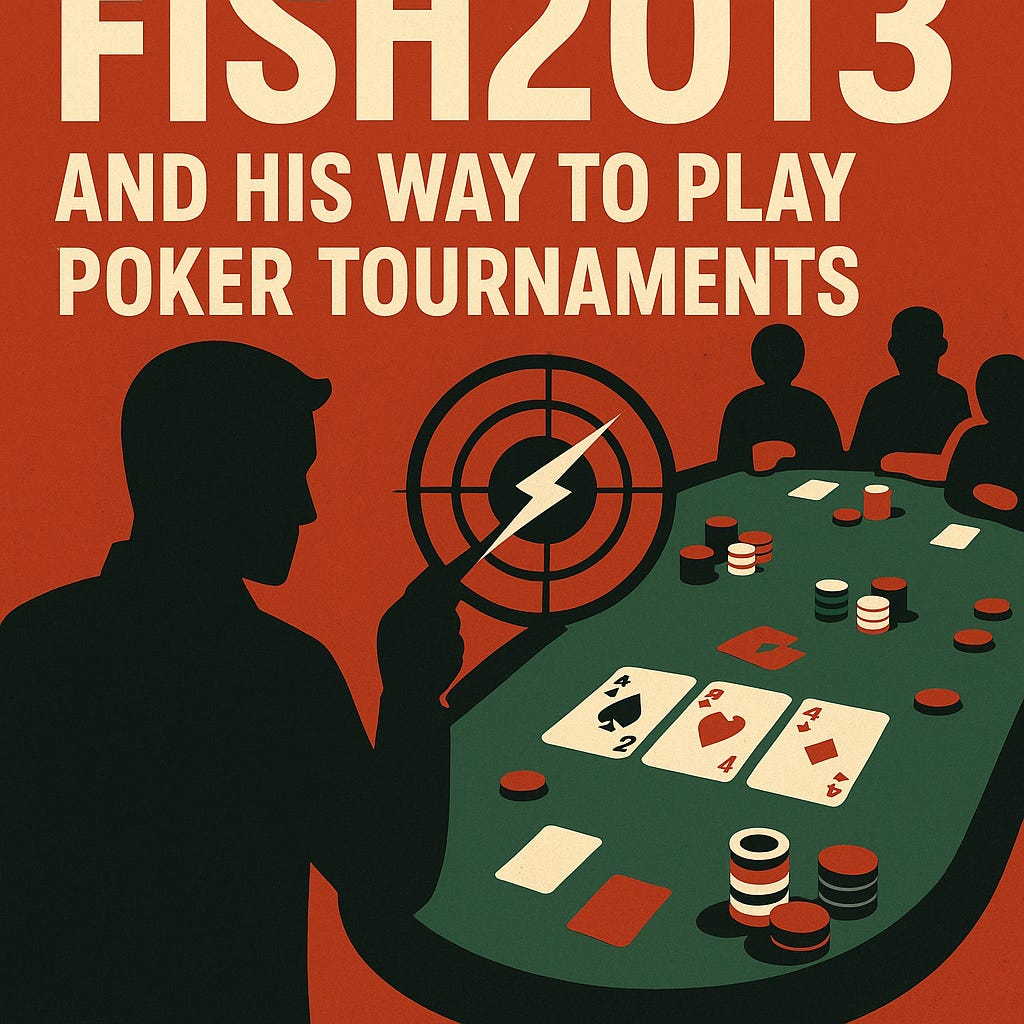
Copy fish2013 and you're probably onto good stuff
Every professional tournament player, from the emerging grinder to the seasoned veteran, confronts the same fundamental question about the structure of their career. A player I work with framed this existential dilemma perfectly, and he even gave us a clue to the answer: if you were playing mid/highstakes online mtts full time, how would you…
-

You Should Bring a Gun to Any Knife Fight
Bob is not an idiot. In fact, if you ask him, he’s probably the smartest guy in poker. While others spend hours grinding solvers, analyzing hand histories, and building data-driven strategies, Bob has cracked the code. “It’s simple,” he says. “Always apply pressure.” Thanks for reading Muchomota! Subscribe for free to receive new posts and…
-
Don't Be Like Bob: Why Mastery Requires Deliberate Practice, Not Just Playing
In today’s fast-paced, digital world, it’s all too easy to fall into the trap of thinking that raw, unfiltered play is the shortcut to greatness. Yet, the cautionary tale of OnlinePoker Bob reminds us that true mastery in any field demands more than just instinct and participation—it requires deliberate, tailored practice. The Rise of OnlinePoker…
-

The Professional Poker Mindset
Introduction Over the years, I’ve worked closely with some of the most successful online poker players in the world. Each of them has their quirks—some are human solvers, others are masters of people-reading, and a few seem to pull brilliant plays out of thin air. But one thing they all share is an antifragile mindset:…
Product Philosophy
Why MOTA exists, and what it does that nothing else does.
-
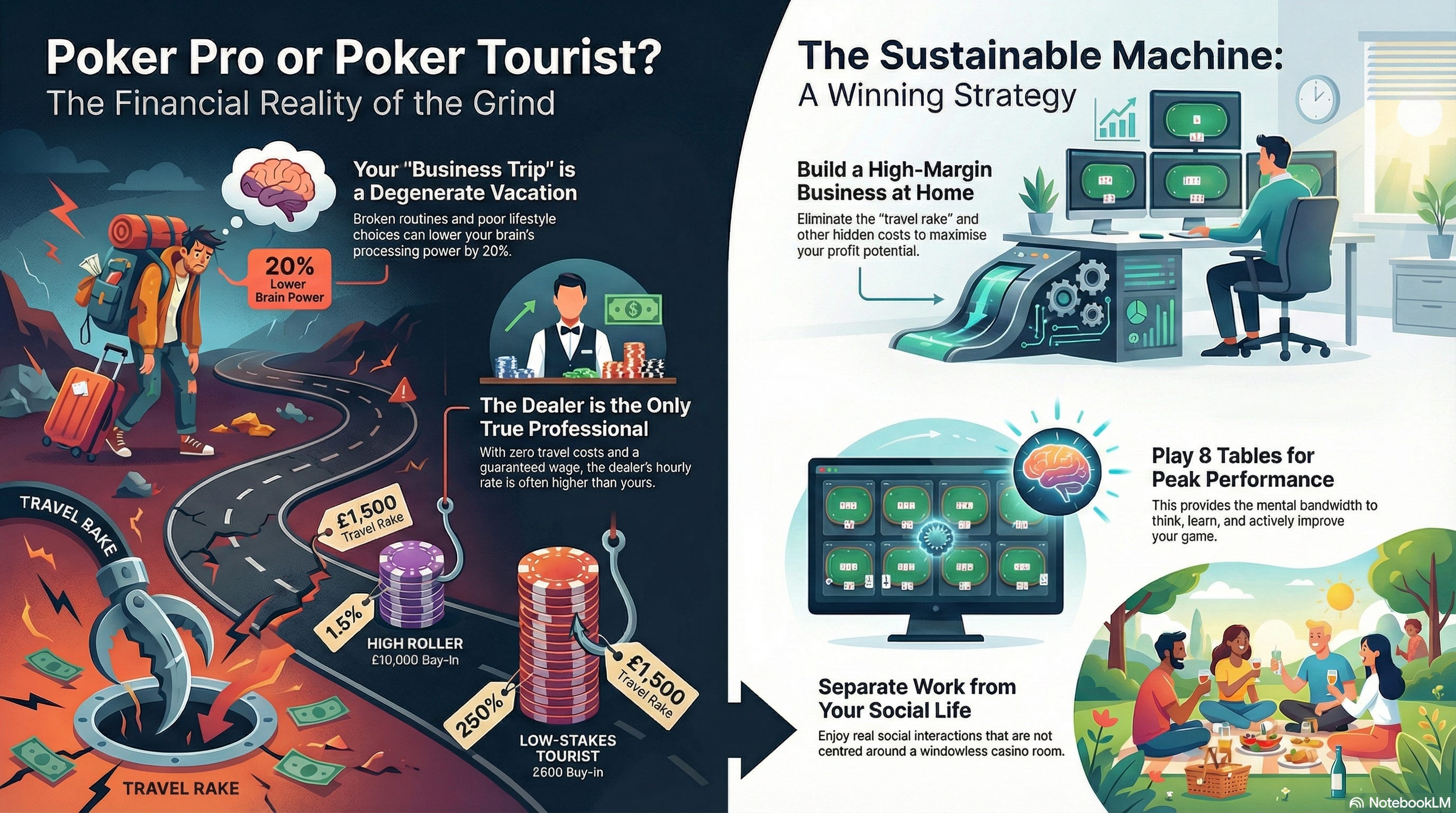
The Mathematics of the Professional Poker Tourist
Date: Jan 30, 2026 Location: Detention Cell #402, [REDACTED] Thanks for reading Muchomota! Subscribe for free to receive new posts and support my work. Status: Humidity 0.01%; Drinking lukewarm water to simulate a steam room Bankroll: $5,000 (Bob), $0 (Sam - currently attempting to bribe a guard with a drawing of a sauna) The walls…
-
The Mota Tool and how much you should sell in the Wcoop Main
For any serious poker player, managing your bankroll effectively is just as crucial as the decisions you make at the table. It’s the foundation of a sustainable and profitable career. But how do you move beyond simple rules of thumb to a more data-driven approach? This is where the Mean Optimized Tournament Alpha (MOTA) Framework…
-

How Unlimited Re-Entries Shift the Field: Pros, Multiple Flights, and Compressed Edges
Poker tournaments come in many flavors. Some events offer a single shot at Day 1 glory, while others let players re-enter—as many times as they like before late registration closes. At MuchoMOTA, we’re fascinated by how these formats reshape the final “in the money” (ITM) field. Today, let’s break down a simple example to see…
-

Why “What Is His ROI?” Is the Wrong Question in Online MTTs
Subscribe now When poker enthusiasts try to measure a player’s skill, one of the first inquiries is: “What’s his ROI?” (Return on Investment). This might sound logical—after all, it tells you how much a player wins per dollar spent on buy-ins. But in online multi-table tournaments (MTTs) , a single ROI figure can be dangerously…
-

MOTA
Mean-Optimized Tournament Allocation: Extending Kelly Principles to Selling Action in Poker Tournaments As a professional tournament poker player, the key to sustainable success lies not just in having a positive expected value (EV) but in optimizing the growth of your bankroll over countless events. The Kelly criterion offers a theoretically sound framework for determining the…
New essays in your inbox.
The MUCHO·MOTA Substack is the home for new writing. No bullshit cadence — posts ship when there's something worth reading, not on a schedule.