← All writing
Variance & Monte Carlo
Bob and Uncle Tau: The Ocean
A zero-mean lottery can’t take your money. A stake you never resized can.
By FelixD
A zero-mean lottery can’t take your money. A stake you never resized can.
The short version
- The Ocean KO draw averages exactly 1x. It can’t take your money.
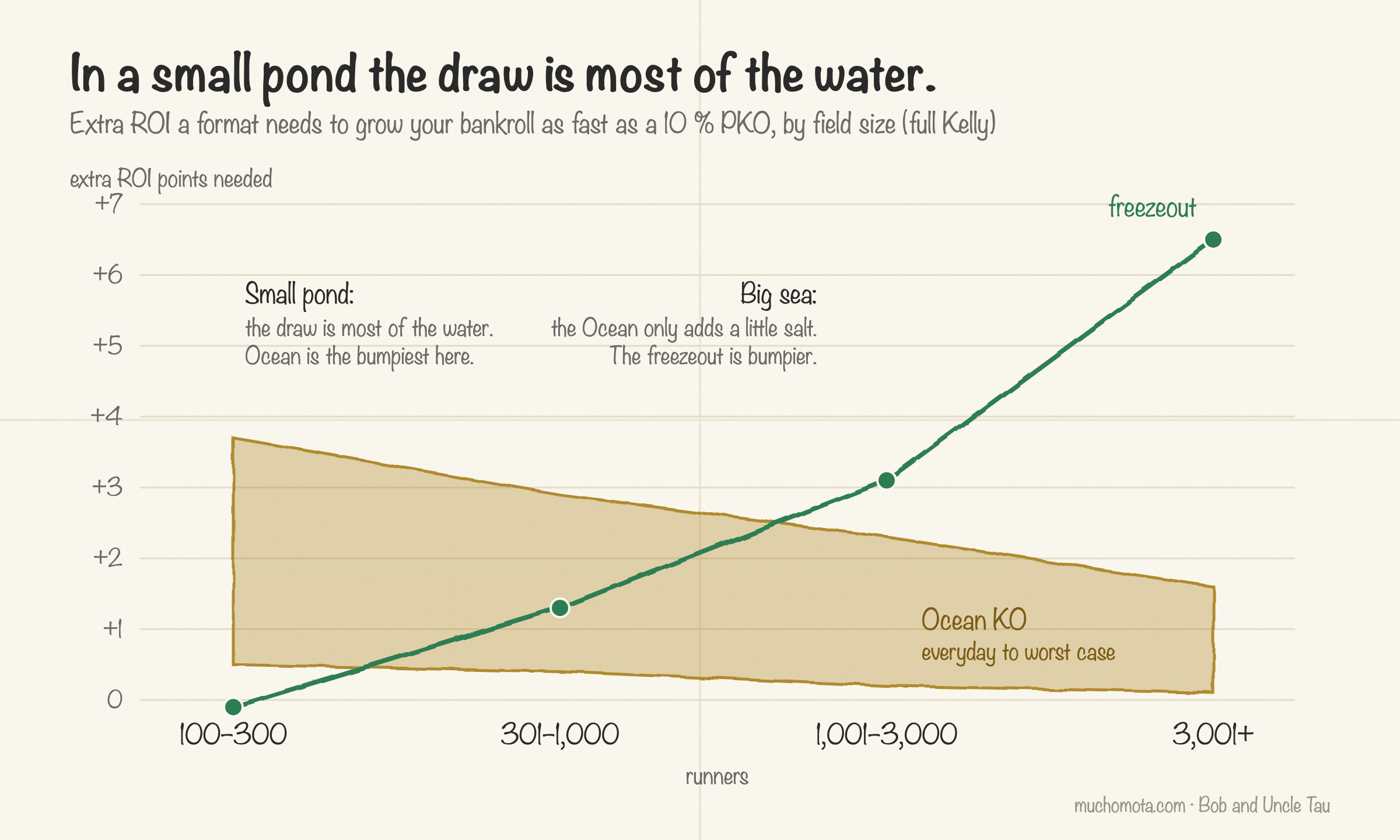
- It does make results bumpier. To grow your bankroll as fast as a normal PKO, an Ocean KO needs 0.5 to 3 points more ROI, depending on field size.
- A normal freezeout in big fields already needs about that much, or more. Ocean KO is not a new kind of danger.
- What breaks bankrolls is playing Ocean KOs at your normal PKO stake. Stake them like freezeouts instead.
Bob came in holding his phone out like evidence. The waiter said “el combo?”, Tau said “not today, amigo,” and Bob put the phone down between the salsas.
The tweet was from a pro Bob respects. Nobody understands the new jackpot bounty formats, it said. Everyone keeps playing their normal buy-in. If GG and Winamax keep pushing them, you get a lot of broke pros, a few rich ones, and stables losing fortunes.
Bob had played four Ocean KOs that week and collected eleven bounties. Nine paid less than face value.
Bob: So it’s a rake on pros.
Uncle Tau: What does the draw pay on average?
Bob: 1x. Supposedly.
Uncle Tau: Not supposedly. GG publishes the table: nine outcomes from 0.4x to 400x, each with its chance. Multiply it out and you get exactly 1. Most draws pay less than face, a few pay a lot more, and it evens out. The house took its fee at the door like always. The draw itself is a fair lottery bolted onto the bounty.
Bob: Then where does a 400x come from? That’s more than the whole bounty pool.
Uncle Tau: From GG, across the whole network. One tournament can’t fund it, so the house books it. It keeps the shortfall on the small draws and pays it back on the big ones. Over all draws it pays out what it took in.
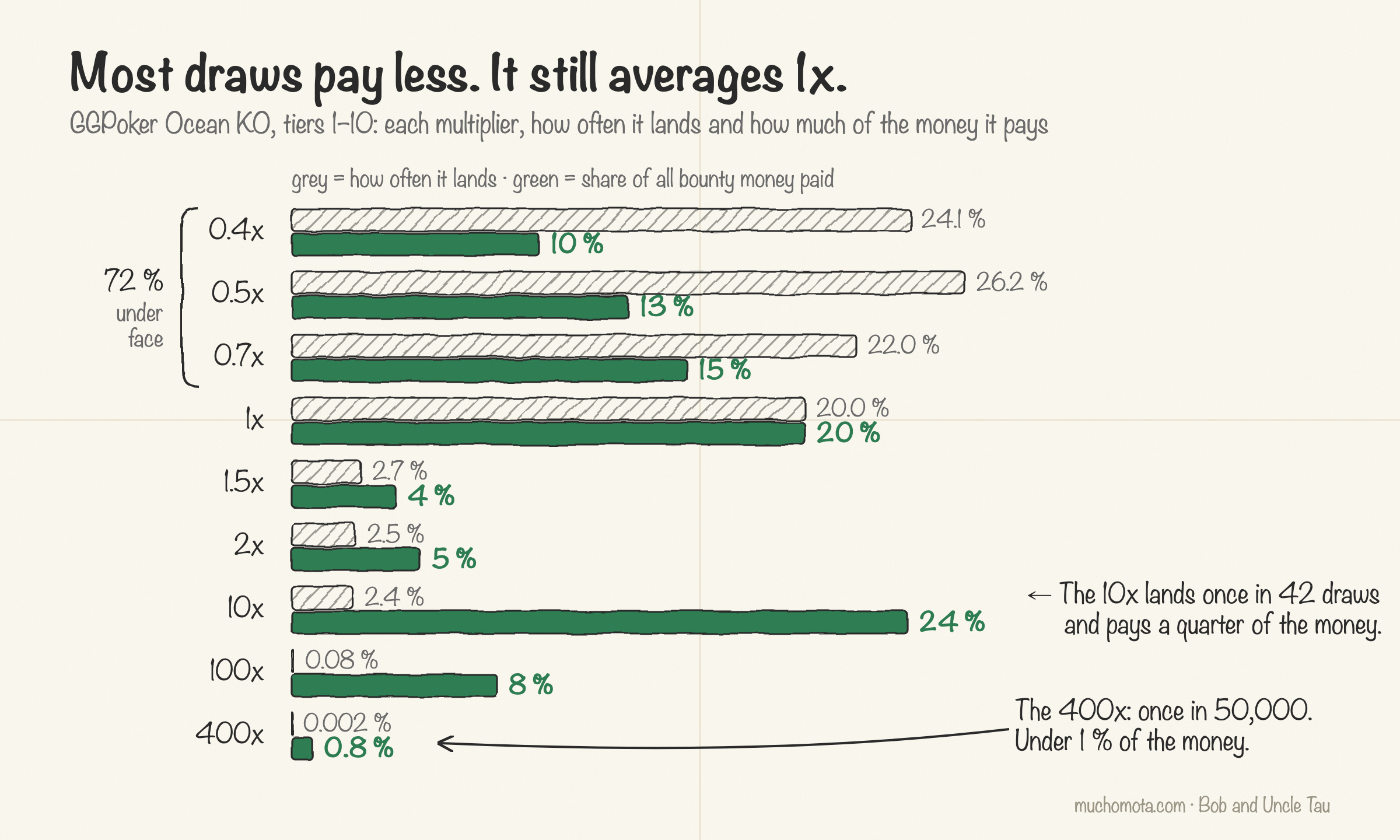
Bob: Same EV, fine. But nine of eleven under face. The variance must be huge.
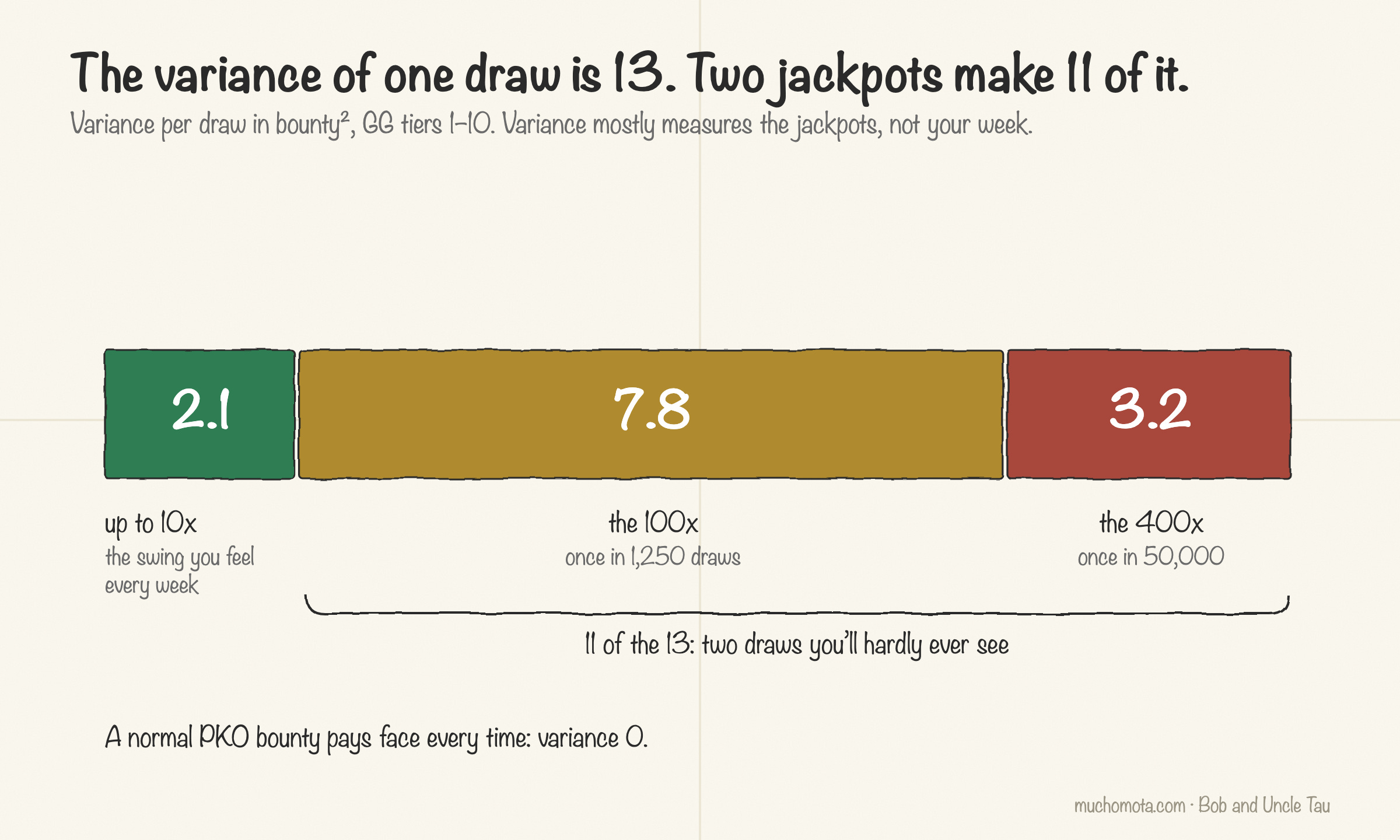
Uncle Tau: It is. Thirteen times the bounty squared per draw, against zero in a normal PKO. Now drop the 100x and the 400x and see what’s left.
Bob: …Two?
Uncle Tau: Two. Eleven of the thirteen come from two outcomes you hit once in 1,250 draws and once in 50,000. The variance number says the jackpot moves every result you’ll ever have. It doesn’t. It moves one result, about once a year. The thing you actually feel week to week is the smaller table, up to 10x. That’s the variance of two.
Bob: And where do those draws land?
Uncle Tau: Mostly late. A regular gets 41 % of his bounty money at final tables and 21 % from the tournaments he wins. The draw multiplies the bounty of whoever you knock out, so the big draws happen on the big bounties, deep in the tournament. The biggest single piece is the winner’s own head, which gets one last draw. That one draw is 60–90 % of the extra everyday swing.
Bob: So how much does it cost me?
Uncle Tau: Not in dollars. In how fast your bankroll grows. Here’s the useful question: if you make 10 % ROI in normal PKOs, what ROI does an Ocean KO need for your roll to grow just as fast?
He wrote on the napkin:
You make 10 % in PKOs. Ocean KO needs:
Field size Everyday case Worst case 100–300 10.5 % 13.7 % 301–1,000 10.4 % 12.9 % 1,001–3,000 10.2 % 12.3 % 3,001+ 10.1 % 11.6 %
Bob: Half a point to three points.
Uncle Tau: Right. The worst case counts the jackpots too, so the truth sits somewhere in between. At 5 % ROI the gap is about two thirds as big.
Bob: And if I play half Kelly, the gap halves?
Uncle Tau: No. That was in the first version of our note and it was wrong. If you play half of the right stake in each game, both lose growth by the same share and the gap stays where it is. Smaller stakes help only if you keep one size for both games. Which brings us to the real problem.
Bob: Three points is still three points.
Uncle Tau: Add one row. Same players, same fields, normal freezeouts.
A freezeout needs, to match the same PKO:
100–300: 9.9 % · 301–1,000: 11.3 % · 1,001–3,000: 13.1 % · 3,001+: 16.5 %
Bob: Wait. The freezeout is worse?
Uncle Tau: In big fields, yes. At 1,000–3,000 runners it needs more than Ocean KO’s worst case. The bounty in a normal PKO pays a little, often, and that smooths your results. Ocean KO roughs that up a bit. A freezeout doesn’t have it at all. You’ve played the Sunday Million for ten years and nobody tweeted about it.
Bob: Small fields?
Uncle Tau: In a small pond the draw is most of the water. In the big sea, adding an Ocean only adds a little salt. Small fields are the one place Ocean is the bumpiest of the three. If the tweet had said “don’t play small-field Ocean KOs at your normal stake,” it would have been right.
Bob: So I keep my stake. Same EV, more noise. The money is the money.
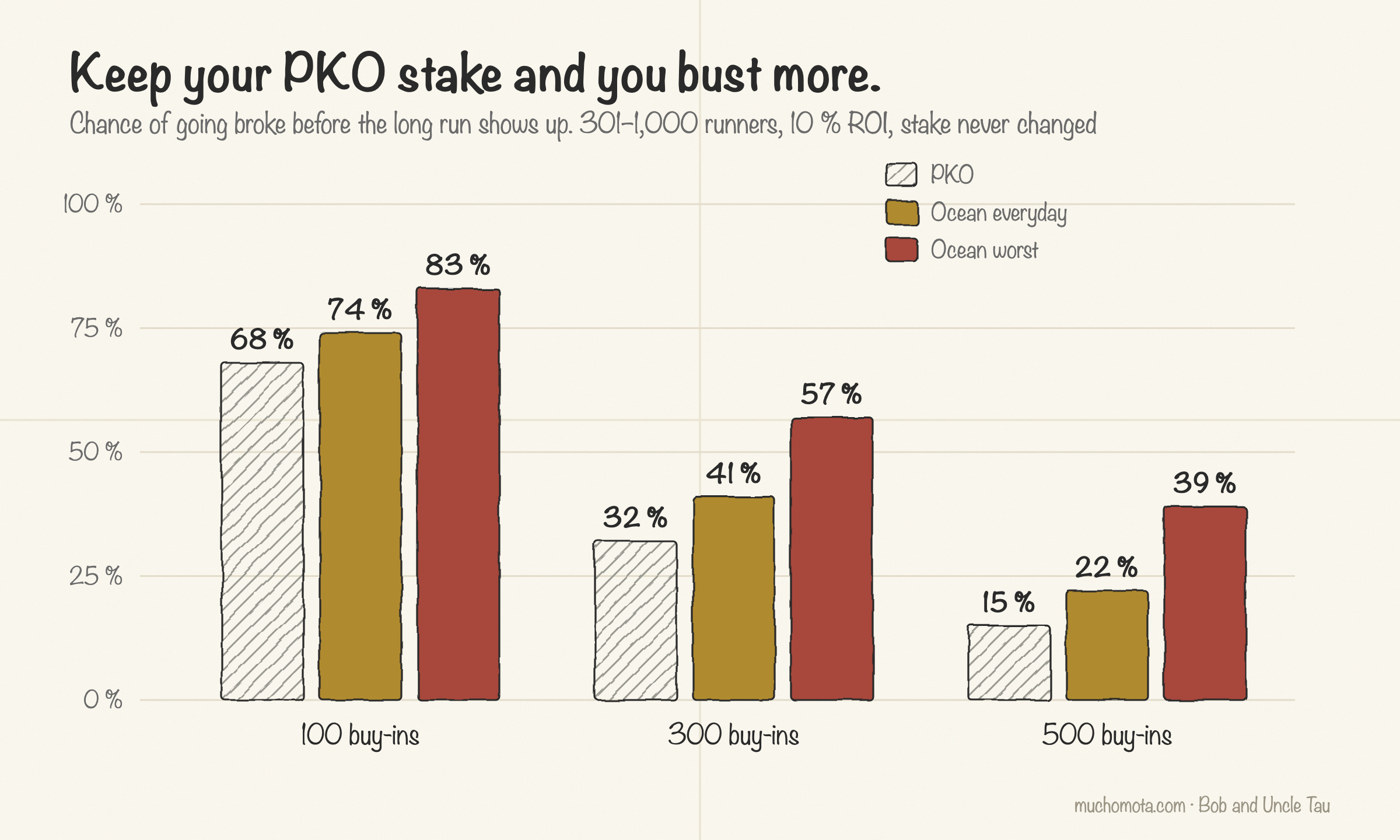
Uncle Tau: That’s true for one tournament and false for a career. Here’s what happens if you never adjust your stake.
Chance of going broke before the long run shows up (301–1,000 runners, 10 % ROI, stake never changed)
Bankroll PKO Ocean everyday Ocean worst 100 buy-ins 68 % 74 % 83 % 300 buy-ins 32 % 41 % 57 % 500 buy-ins 15 % 22 % 39 %
Bob: 68 % in a normal PKO?
Uncle Tau: At 100 buy-ins in big fields, yes. That’s another post. Look at the direction. Treat Ocean KOs like freezeouts, not like PKOs. The right freezeout stake is already a quarter smaller than the PKO stake at 300–1,000 runners, and half at 1,000–3,000. That covers Ocean’s everyday swings with room to spare. Keep your PKO stake and you’re overbetting. Most pros already overbet PKOs. Ocean pushes them from slow growth to none.
Bob: So the tweet is right.
Uncle Tau: Right about broke pros, wrong about why. Nobody is losing EV to the draw. They’re losing bankrolls at a stake they never changed. And that money doesn’t leave poker. It changes hands and gets raked again.
Bob: If the house makes nothing on the draw, what’s it for?
Uncle Tau: Keeping players. A recreational player who makes twenty knockouts a week hits a 10x every other week and a 100x about once a year. Same expected loss, many more reasons to come back. Mystery bounties and Spin & Gos work the same way. The pros who don’t resize add to the pool, and the rake comes off all of it.
Bob: Say it back to me.
Uncle Tau: Three things.
Bob: I’m not doing that at the table.
Uncle Tau: You don’t have to. The calculator does it.
Bob: And the 400x?
Uncle Tau: Marketing. It’s less than 1 % of the table’s value. If it ever hits you, buy the waiter el combo.
The waiter, who had been pretending not to listen, said “el combo?”
Uncle Tau: Not today, amigo.
Bob turned his phone face down.
Bob: Same city.
Uncle Tau: Same city. Bumpier road. Smaller car.
Run your own numbers. The free Ocean KO calculator shows what a bounty is worth for your bankroll, the odds at every tier for GGPoker Ocean KO and Winamax Space KO, and the ROI each format needs against your PKO. No sign-up.
The numbers behind the napkin
References: J. L. Kelly Jr. (1956), “A New Interpretation of Information Rate,” Bell System Technical Journal 35:917–926. GGPoker, “Ocean KO” blog post and client multiplier table, October 2026. muchomota tournament archive, PokerStars PKO and freezeout results 2023–2026.
Free Substack — subscribe to get new posts as they ship. No upsell.
Field, buy-in, ROI and volume: see the range of outcomes and how deep the downswings get. No sign-up.
The Finnish high-stakes legend Elmerixx famously said that at the highest levels, " Our job is to handle uncertainty." This is a deceptively simple statement. It is also the most precise and complete description of the professional poker problem. When stripped of its romanticism, the job boils down to the management of a single physical…
In the high-stakes world of tournament poker, risk isn’t just a possibility—it’s a prerequisite for greatness. The audacity to flirt with a 6–7 figure downswing is not a mark of failure but a badge of having truly entered the arena of the elite. After all, you can only lose millions if you’ve first convinced someone…
Mystery Bounty tournaments have carved out a niche in the poker world with their blend of randomness, skill-driven knockout collection, and highly skewed payout distributions. While recreational players flock to these events for the chance at a “golden bounty,” professionals face a tradeoff: the potential for increased mean ROI due to softer fields versus higher…